

Lieutenant Colonel 15361, 2nd Battalion, Royal Fusiliers (City of London Regiment).
Died 30 May 1940. Aged 42. Buried in Coxyde Military Cemetery, West-Vlaanderen, Belgium.
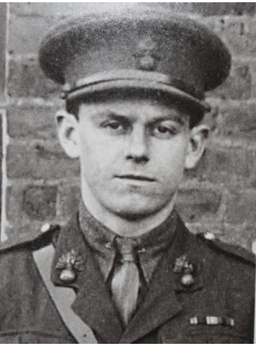
Family
Geoffrey Thornton MacArthur Allen was born on 13 March 1898 in Woollahra, in the Eastern suburbs of Sydney, just inland from Bondi. His great-great-grandparents had moved to Australia from England in 1816.
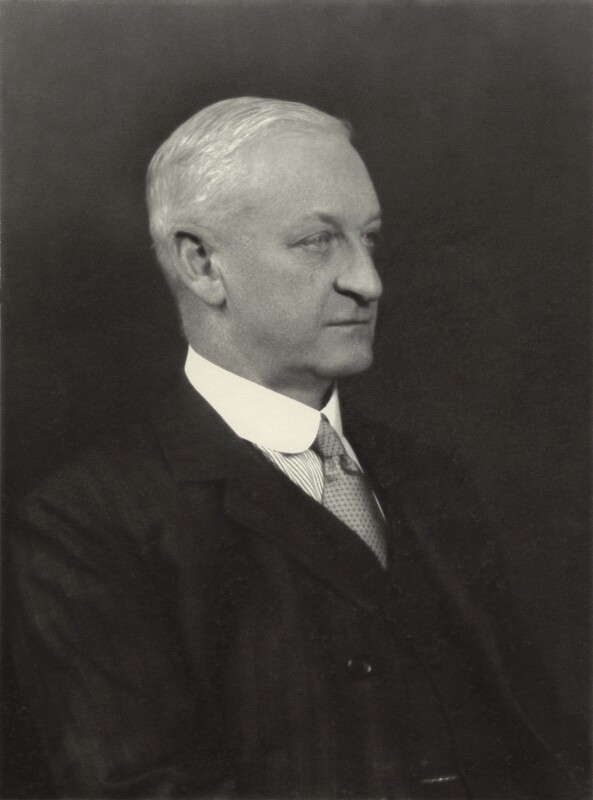
Geoffrey’s father was Sir Walter MacArthur Allen, K.B.E., son of the politician, Sir Wigram Allen, KCMG. Sir Wigram was educated at Trinity Hall, Cambridge and was called to the bar by the Inner Temple in 1896.
Geoffrey’s mother was Lady Marguerite Julie Allen, known as ‘Pearl’. She was the daughter of Edward Lamb, formerly Minister of Lands, Queensland.
Walter and Pearl married in 1896. They had three children, all born in Sydney: Geoffrey Thornton MacArthur, George Oswald Browning, born c1903, and Patricia Marguerita, born c1906.
Life in Datchet
The family moved to the UK sometime after Patricia’s birth. In the 1911 Census, Walter, Pearl, George, age 8, and Patricia, age 5, were living at Murton, a Victorian House on Montagu Road in Datchet. With them were a governess, a nurse, a cook and a housemaid. Geoffrey would have been 13 at that time and was not with the family on the night of the census. Perhaps he was away at school? (Murton was demolished to make way for Saffron Close in the 1960s/70s, but would have been next door to number 42, Norham.)
The family later moved to Wyndleshore on Windsor Road in Datchet and are recorded there in the Register of Electors for 1918. Geoffrey was on the Absent Voters List in 1918 at that address. The family left Datchet around 1923, although Pearl returned to Montagu Road during WWII.
Although the 1911 Census listed the family as ‘visitors’, they seemed to abandon any plans of returning to Australia. In 1914, Walter became an assistant staff officer at the Metropolitan Special Constabulary. He became Director of Supplies between 1915 and 1917, then staff officer from 1918 to 1924. He was a Commander of the Order of St John of Jerusalem. In 1918 he was awarded the OBE, in 1920 the CBE, and in 1920 was advanced to KBE. He became Commandant-in-Chief of the Metropolitan Special Constabulary from 1925 until March 1943 when he resigned for health reasons.
Military service
Geoffrey obtained his commission in 1917 and saw active service in WWI as a Lieutenant in the 1st Royal Fusiliers. In 1921, he received the MBE for services in Ireland. From 1924 to 1927 he was adjutant and was promoted to Captain in 1926. He was in India from 1928 to 1932 as GSO (General Staff Officer) and served in a similar capacity in the Western Command in 1935-36, followed by two years as Staff Captain at the War Office, becoming a Major in 1938.
In 1930, at the age of 32, Geoffrey married Ruth Elaine Felicity Freeth at Brompton Holy Trinity Church in London.
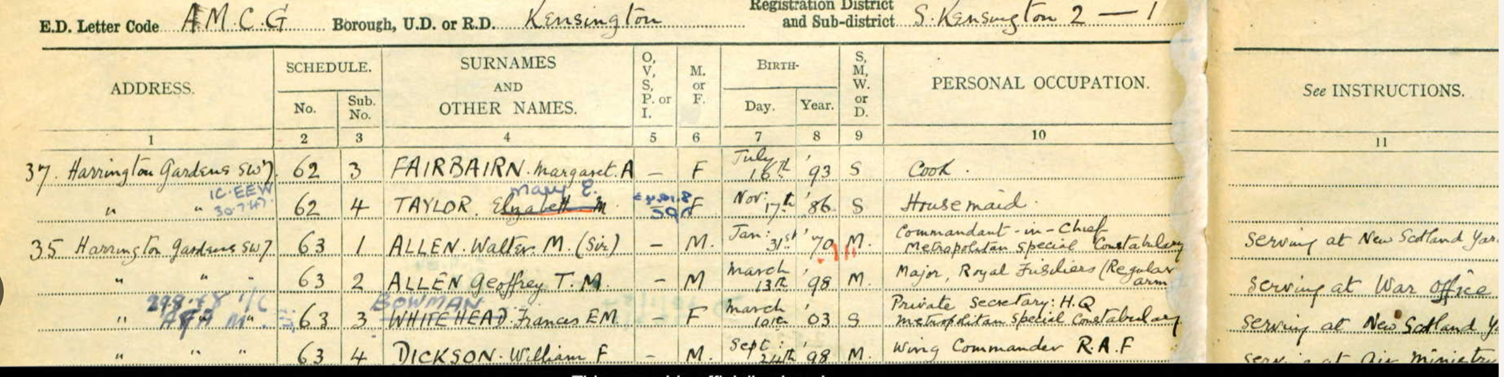
In the 1939 Register, Geoffrey was recorded at 35 Harrington Gardens, Kensington SW7, with his father and brother-in-law and a secretary from New Scotland Yard where his father worked. He is listed as a Major in the Royal Fusiliers. (Another person was also living there but their details have been redacted. Individuals’ details are redacted from the Register for 100 years after their birth or for people who are still alive.)
Second World War
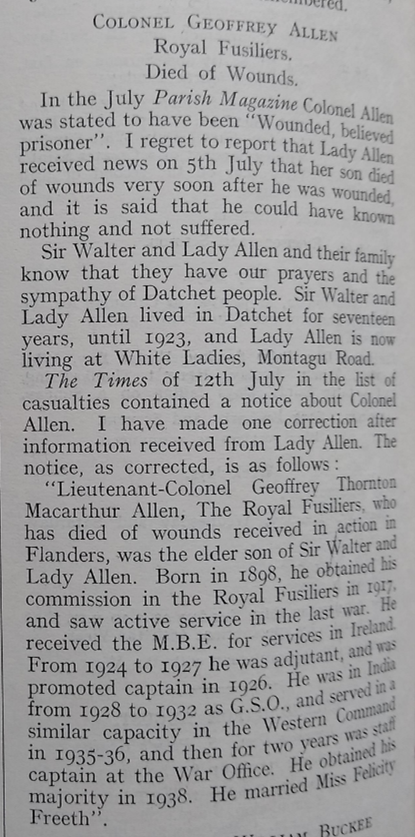 In July 1940, Datchet’s Parish Magazine reported that Lieutenant Colonel Geoffrey Allen, Royal Fusiliers, was wounded, believed prisoner. At the time, his mother, Lady Allen, was living at White Ladies, now 34 Montagu Road. The Magazine reminded its readers that the Allens had lived in Datchet for 17 years until 1923.
The following month, August 1940, Datchet’s Parish Magazine reported that Lady Allen had received the news on 5 July that her son had died of his wounds very soon after he was wounded; ‘It is said that he could have known nothing and not suffered’.
Geoffrey’s siblings
Geoffrey’s brother, George Oswald Browning Allen, an England Test Cricket Captain known as ‘Gubby’ Allen, also served in WWII. According to his biography on the Wikipedia website, in 1940 he was appointed as an anti-aircraft liaison officer to RAF Hawkinge. Later that year he became a flak liaison officer to Five Group, an RAF Bomber Command Group responsible for distributing intelligence on German air defences, collated by Military Intelligence, to bomber stations. He was later appointed to lead the Military Intelligence MI14E section. He remained in this position for the rest of the war and was promoted to Lieutenant Colonel when MI14E became ME15. He left the military in 1945.
In a obituary about his father, Sir Walter, printed in The Times, 6 December 1943, Sir Pelham Warner wrote: I only saw him bat once in a net in his garden at Datchet and he had a very pretty style. He was also a very good lawn-tennis player and golfer, and here too his style was built on sound lines. …/… He took the keenest pride and interest in G. O. Allen’s cricket but told me he went through agonies while watching him play in a big match. It was Sir Walter who made a witty remark during the Test match at Lord’s in 1936 when Don Bradman was playing his great innings of 294. He was sitting on the top of the pavilion next to A C MacLaren, who kept on remarking, “Yes, I know he’s pretty good, but he’s got a bit to learn”, Finally Walter said “Look here Archie, if he learns much more he will ruin the game!”
In 1932, Geoffrey’s sister, Patricia, married William Forster Dickson, later Air Vice Marshall Dickson. They had two daughters, one of whom died in her teens. William was appointed OBE (1934), CB (1942), CBE (1945), KBE (1946), KCB (1952), and GCB (1953). He died on 12 September 1987 at the Royal Air Force Hospital, Wroughton, Wiltshire. Patricia died in December 2000, age 95, in West Berkshire.
Remembered in Datchet
Geoffrey does not appear on Datchet’s War Roll for WWI although he is remembered on Datchet’s War Memorial for his service in WWII.