

THE HOME GUARD
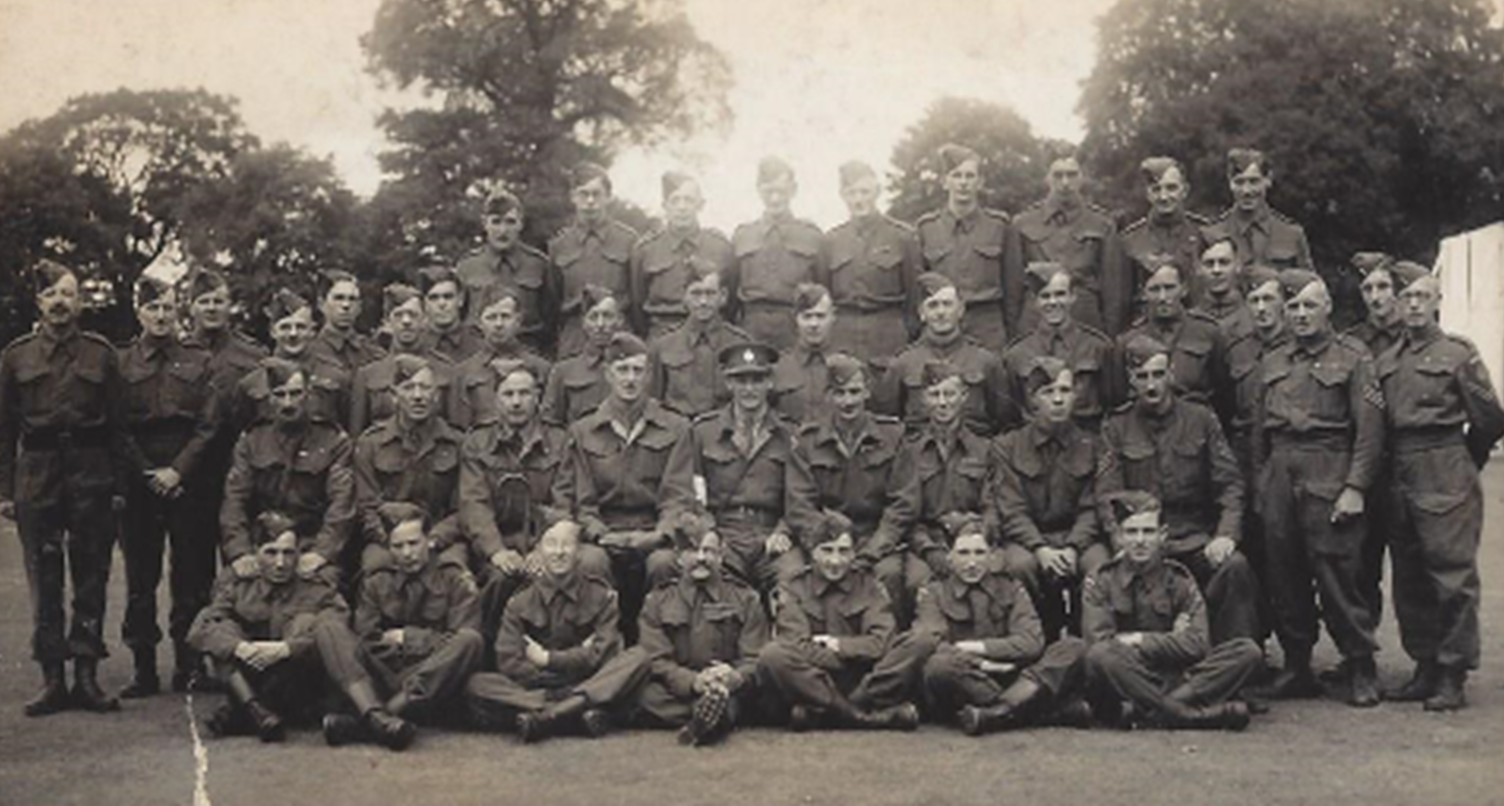
In 1940, the Local Defence Volunteers (LDV) were renamed the Home Guard. Datchet’s infantry Home Guard was most likely a platoon of the 9th Buckinghamshire (Slough Town) Battalion of the Home Guard which was affiliated to the Oxford and Buckinghamshire Light Infantry. It was, at first, under the command of two local men, Captain Wilfred Good and Captain John Hathaway. (Captain Good joined the Royal Artillery in December 1940. He was killed in action in 1944, aged 31, and is remembered on Datchet’s War Memorial. Captain Hathaway had left the Home Guard by 1941. He was in the Territorial Army and survived the war.)
Datchet also had an anti-aircraft battery at the Polo field on Horton Road (now the site of the reservoir). It was manned by the 71st (Bucks and Berks) Home Guard Heavy Anti-Aircraft Battery Royal Artillery (Windsor and Datchet) which was established in 1942.
In Datchet Past, Janet Kennish writes that Churchmead House on Slough Road was requisitioned by the Royal Artillery and also used by the Home Guard, while the stables at Datchet House on London Road were used for storage.
There was also a Home Guard ‘navy’, known as the Upper Thames Patrol (UTP), which protected the river from Lechlade to Teddington. They were nicknamed ‘Up The Pub’ as their local headquarters were often riverside pubs, and they patrolled their areas mostly in private launches, with the owner being a member of the crew. Mr Killick, who lived at the Manor House, was one of the Datchet boat owners who joined the local UTP.
Datchet Home Guard Rifle Team
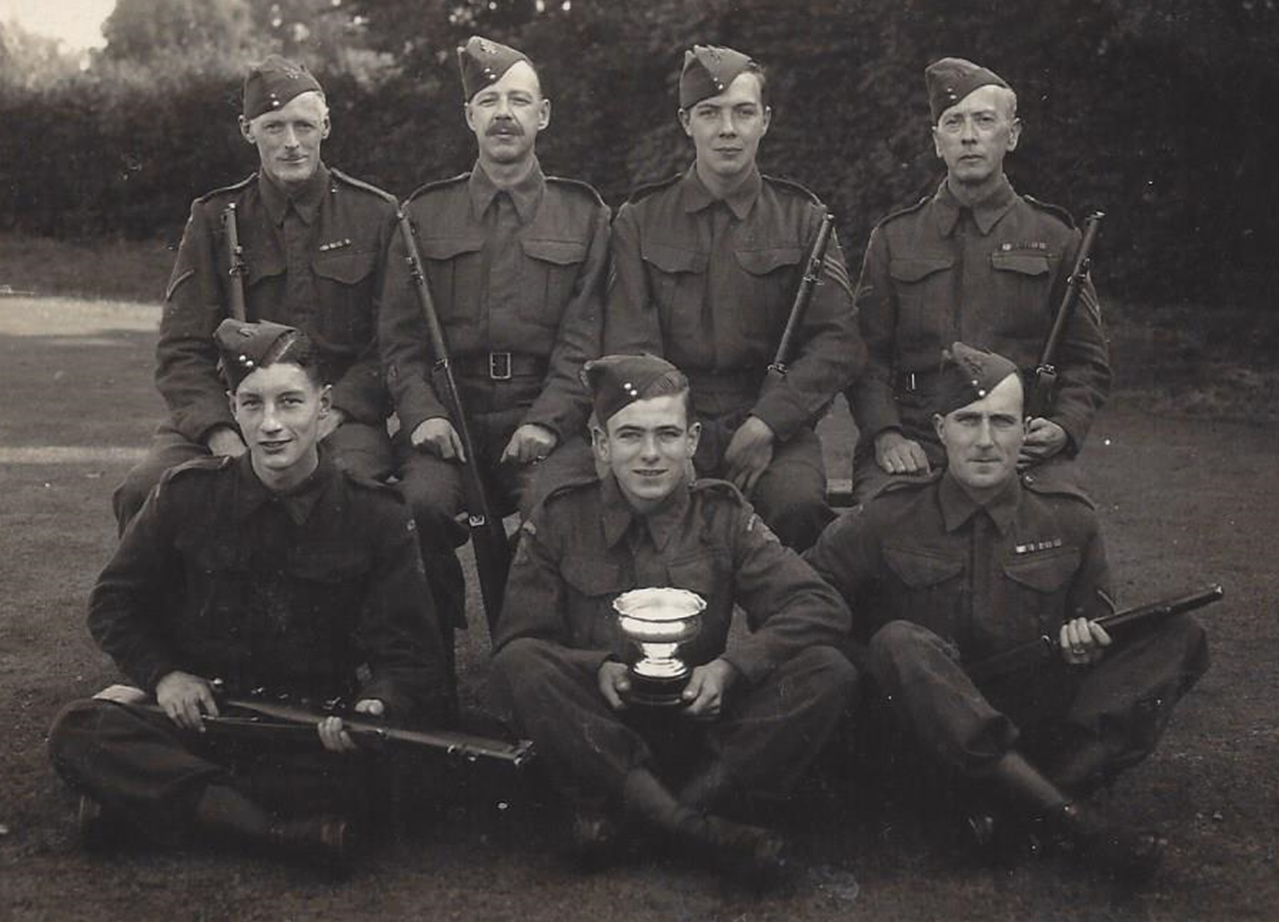
Rifle Clubs originated out of the local Home Guard units.
Barry Lloyd kindly sent us this photograph for our DVS archive. His father, Charles Albert Lloyd, is cross-legged on the left of the image.
Charles, from Hill Rise, Colnbrook, served in the Datchet Home Guard during WWII and on an Anti-Aircraft Battery with the Windsor Castle Defence Battalion. He worked as an engineer at Fairey Aviation at the time, at the Great West Aerodrome (now Heathrow). It was where Fairey tested their aircraft and Barry says his father often flew as ballast!
Les Smith’s reminiscences of the Datchet Home Guard
The late Les Smith from Montagu Road, born in 1924, was in the Datchet Home Guard. Before he died his son, David, recorded some of his father’s memories to share with us here:
“It was while training to be an engineer I enlisted with Datchet Home Guard. We would train in the evening and undertake many exercises sometimes with Windsor Home Guard on Home Park. The Datchet Home Guard was made up of mainly older men and I was very much one of the youngest.
“The show Dad’s Army showed a very comical picture of the Home Guard which I can relate to as there were many situations that are both amusing now and at the time. We were on exercise in Datchet one evening with the objective to look out for Germans from hidden positions. My position was up a tree on Datchet Golf Course and I remember saying whilst up the tree, ‘What do I do if I see a German?’ I was advised to make a sound like an owl!
“As amusing as that was during an exercise, it was not at all funny when reality hit and a German parachutist was spotted coming down one evening at Southlea farm. Unarmed, we spread out searching the undergrowth all night. We never found anyone.
“Datchet also had an anti-aircraft base which was just up from the old Rising Sun pub (on Horton Road) and on what used to be the Guards’ Polo field. One of my frequent jobs was to take messages on my bike from the Anti-Aircraft base to the Command Centre in Slough. I can remember having to pull over often to shelter under trees as red-hot metal rained down across the road from the anti-aircraft guns.
“I also remember being shouted at by the sergeant while we trained, loading the shells into the gun. He felt I was too slow and pushed me aside to show me how it was done. In doing so he jammed his fingers in the mechanism and had to retire to the First Aid post!
“Despite just living just a few hundred yards from the army base at the time (Woodland Villas), I spent many nights either on operations or sleeping in the bunk houses on the anti-aircraft base.”
With many thanks to Les and David Smith.
Forgotten bombs
Local historian Derek Hunt told us that, in Windsor at least, the Home Guard was also remembered for the legacy of lethal weapons they left behind. They produced large quantities of home-made bombs for use against German tanks in the event of an invasion. These bombs were hidden away and, in many cases, forgotten until they were discovered by accident almost 50 years later. Three people were injured when several bombs exploded on a building site in King’s Road, Windsor, in November 1988. More bombs were discovered at the same site in April 1989, and in December 1993 workmen in Bolton Road dug up yet more bombs. On each occasion, army bomb disposal units were called in to deal with all the bombs.
A SPARE BRIDGE IN DATCHET
Materials for a 120-ft span Callender-Hamilton bridge across the Thames were stored somewhere in Datchet during the war. A Callender-Hamilton bridge is a modular, portable, pre-fabricated truss bridge. It was primarily designed for use as permanent civil bridging as well as for emergency bridge replacement and for construction by military engineering units. The strong and simple design is made up of individual lengths of galvanised steel bolted together with galvanised high-strength steel bolts, all of which require torque settings
NEWSPAPER REPORTS
Newspaper reports from the era offer clues to what life was like in Datchet during WWII and the types of stories which were reaching home from overseas. The following articles all appeared in the Windsor, Slough and Eton Express.
14 JUNE 1940 PLACE NAMES DISAPPEARING
The thoroughness with which the authorities are proceeding to obliterate all place names which might be of use to parachutists or other invaders is indicated by instructions which have been given to Datchet Parish Council by Bucks County Council. The Parish Council have been told that they must obscure with putty and paint the name of the village on the War Memorial and the marble drinking fountain on the village green. Road signposts and the name boards on the railway station have already been removed and church signs bearing the place name are also to disappear.
14 JUNE 1940 ELECTRIC BULBS VANISH
Some people living in Datchet have taken exception to the ‘twilight’ streetlamps which helped the villagers to find their way about during the blackout last winter. The bulbs are constantly disappearing, and the Parish Council was informed at their meeting on Wednesday that they were taken by people who considered that the lights were visible from the air. It was stated that the lights conformed to regulations and constituted no danger to the village.
Christmas 1940 A CHRISTMAS TREE
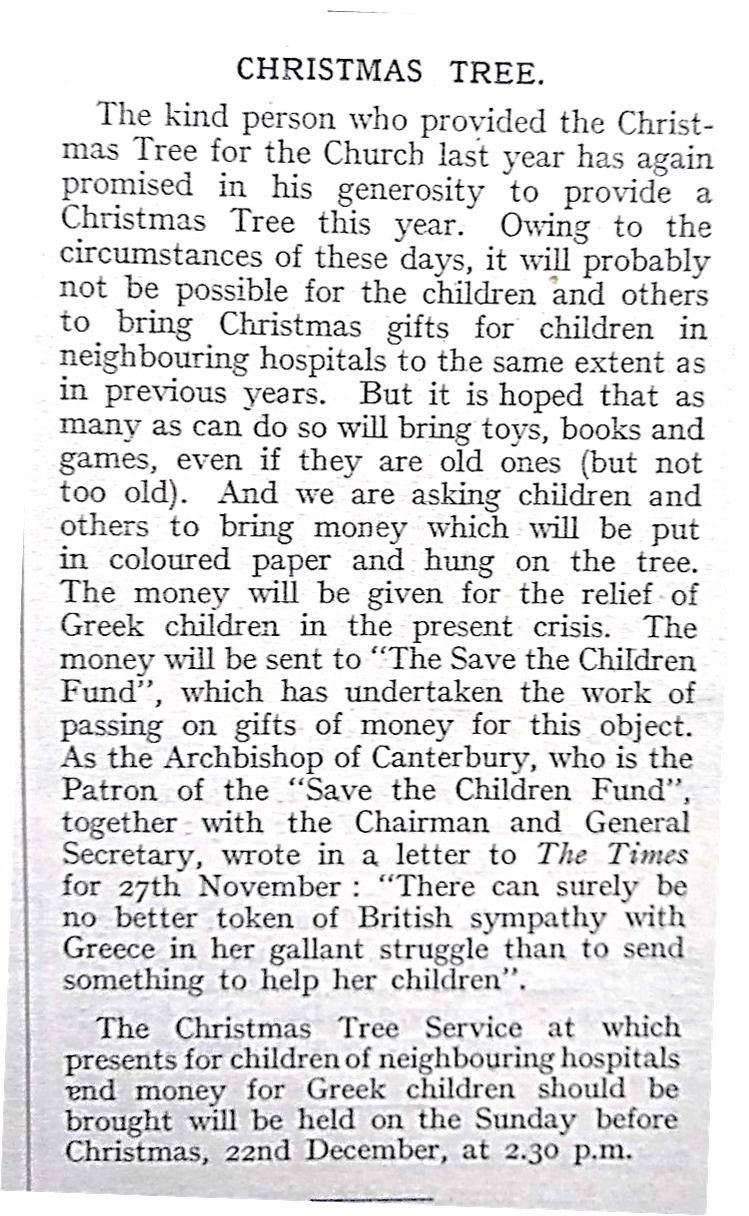 In 1940, Datchet’s Parish Magazine reported that a Christmas Tree had been donated to the Church, however, it was acknowledged that it would probably not be possible for gifts to be provided for children in local hospitals to the same extent as previous years. The Church asked for money donations which would be first put in coloured paper and hung on the tree, then sent to the Save the Children Fund for the relief of Greek children.
Christmas 1942 – A CHRISTMAS SURPRISE
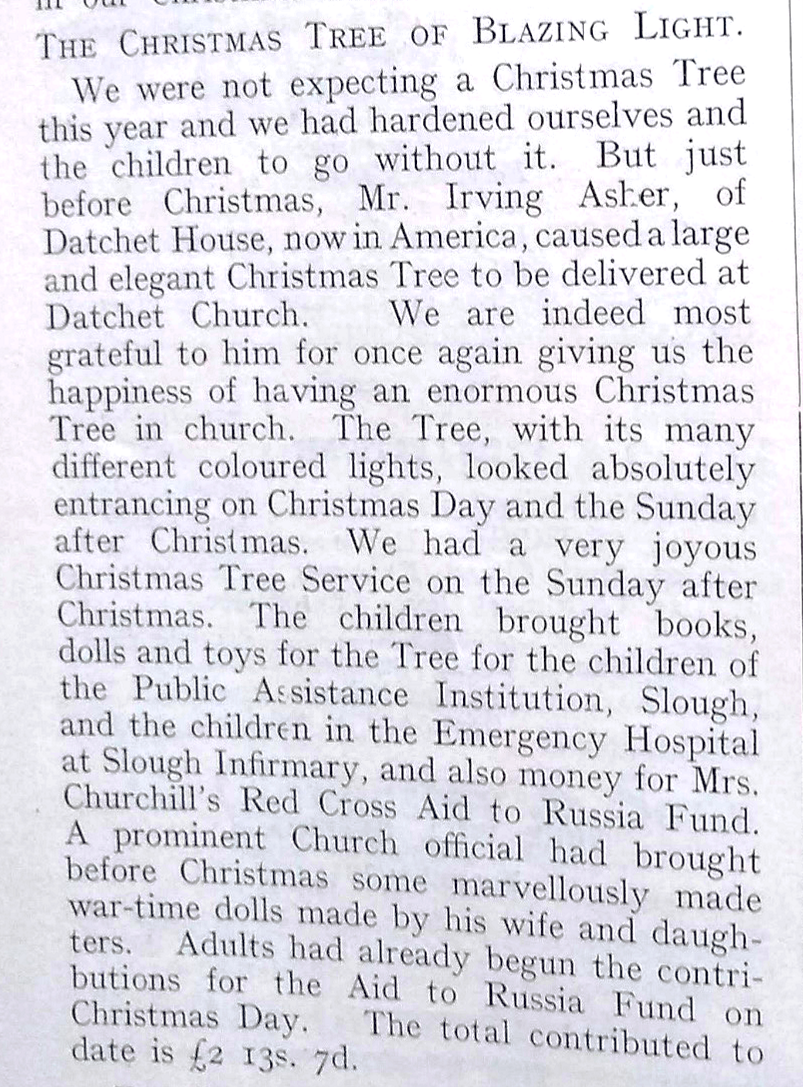 In 1942, the village was not expecting to have a Christmas Tree in the Church but Irving Asher of Datchet House, London Road, (a film producer and husband of actress Laura La Plante) who was in America at the time, surprised everyone by arranging for a tree to be delivered.
As in previous years, the children brought books, dolls and toys for the tree, which were passed on to the children of the Public Assistance Institution and at the Emergency Hospital in Slough; and the wife and daughter of a church official had made some war-time dolls to donate.
Money was also donated to Mrs Churchill’s Red Cross ‘Aid to Russia Fund’. The school also collected £10 separately, from donations and the sale of articles made by staff and children. They received a personal letter of thanks from Clementine Churchill.
13 APRIL 1945 UNUSUAL STORY FROM BURMA
Here is the story of the queerest casualty of the war. It is contained in a letter from Sgt H Pickton whose home is at Lawn Close, Datchet, and who is with the Royal Berkshires in Burma. He writes: “We are at the moment having a few days’ break, being safe from small arms fire, but the Japs send us a few shells to let us know that he has not forgotten us. Yesterday one of his shells landed in the river close to us. At the time, I was having a dip with another local boy, Col J Vass from Windsor. The force of the explosion brought fish to the surface and, needless to say, we soon caught some. Swimming around, I caught a queer-looking fish with a kind of spiked fin. On getting to the bank, I threw it up and one of the boys caught it, but a fin went into his hand. He tried to extract it himself, but no, the fish would not give in. He was taken to the Medical Officer who could not get it out and eventually went off in a jeep with the fish still stuck in his hand and holding it with the other hand! “He is now going on well without the fish, but he complained that I might have cooked him some chips.”
21 AUGUST 1942 DATCHET LEADS: OTHERS FOLLOW
Datchet has set an example which big towns and small villages all over the country are following. This is the weekly sale of surplus vegetables, the popularity of which continues to increase. At the meeting of the Parish Council on Wednesday the food production committee said the producers were satisfied and so were the public who obtained fresh vegetables. Mr E W Page, chairman, said they had received letters from towns and villages all over the country asking for details of their scheme.