

Should these servicemen’s names be added? Are other names missing?
If you would like to help us with this research, please get in touch
ELLIOTT, Charles William 1908-1942
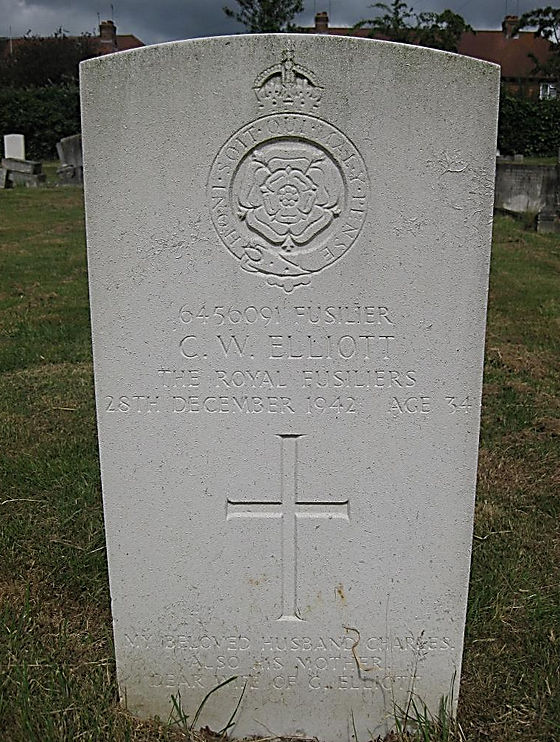
Charles was a Fusilier with the Royal Fusiliers (City of London Regiment). He was with his regiment in the retreat to Dunkirk but afterwards was invalided out of the army. He lived with his wife, Frances, and daughter, Deborah, at 2 Westview Cottages, Horton Road, Datchet.
Charles died at Lewisham Hospital on 28 December 1942, aged 34, as a result of his war service. He is buried in Datchet Cemetery with a Commonwealth War Graves Commission headstone, left. The inscription at the bottom of the headstone reads ‘My beloved husband, Charles, also his mother, dear wife of G Elliott’. Charles was the son of Gentie and Amy Elliott who are recorded with their family in the 1921 Census at Westfield Cottages, Horton Road. As yet, we do not know why he is not remembered on Datchet’s War Memorial.
One reason for his omission from the war memorial might be that the WWII servicemen’s names were not added until 1989/90. The project was led by Datchet Parish Council (DPC) and funded jointly with RBWM and the British Legion. DPC does not have any records which show how the names were selected but they appear to have been sourced from the WWII War Roll published in the Parish magazine in 1947, and the Book of Remembrance in the Church. Charles Elliott is not included in either of these, even though his death was reported in the Parish magazine in 1943.
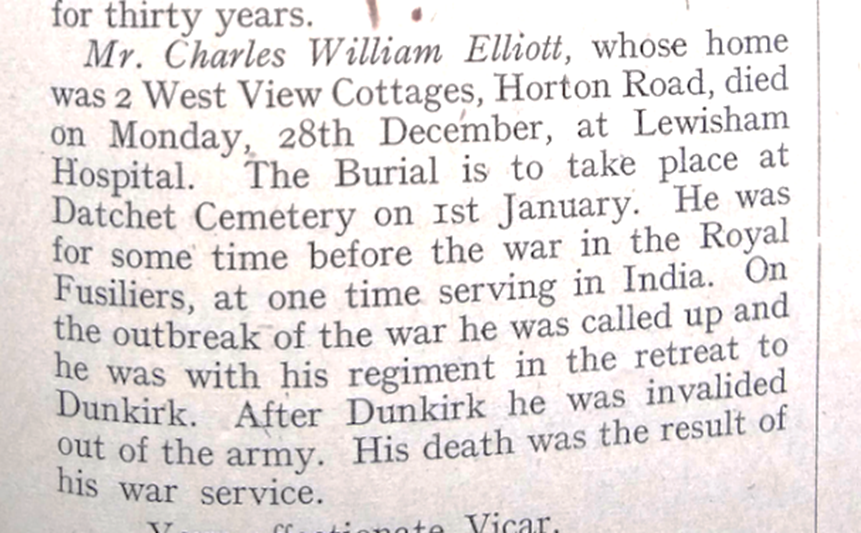
An article in Datchet Parish Magazine January 1943, above, confirms that Charles died as a result of his war service.
RICKCORD John Scott 1920-1939
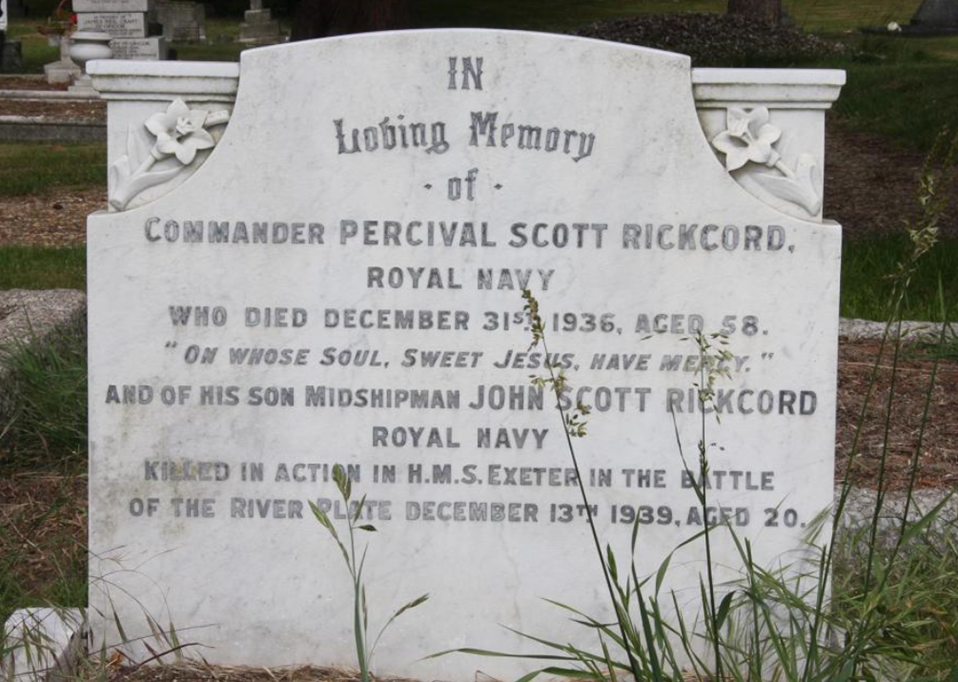
Born in Godstone, Surrey, John Scott Rickcord was a midshipman in the Royal Navy, serving aboard HMS Exeter. He died on 13 December 1939 during the Battle of the River Plate, off Uruguay, when his ship suffered the loss of 61 crewmen.
John was the son of a retired Royal Navy Commander Percival Scott Rickcord, who was Honorary Treasurer of both Datchet Golf Club and the Datchet Nursing Association. The family lived at Beaulieu on Windsor Road from around 1928 until 1936 when Cdr. Rickcord died. John has no known grave and is not remembered on Datchet’s WWII memorial, possibly because his family had moved to Crowthorne before the war. He is, however, remembered on the Plymouth Naval Memorial and on his father’s headstone in Datchet Cemetery, pictured above.
RICKCORD Anthony George, 1921-1941
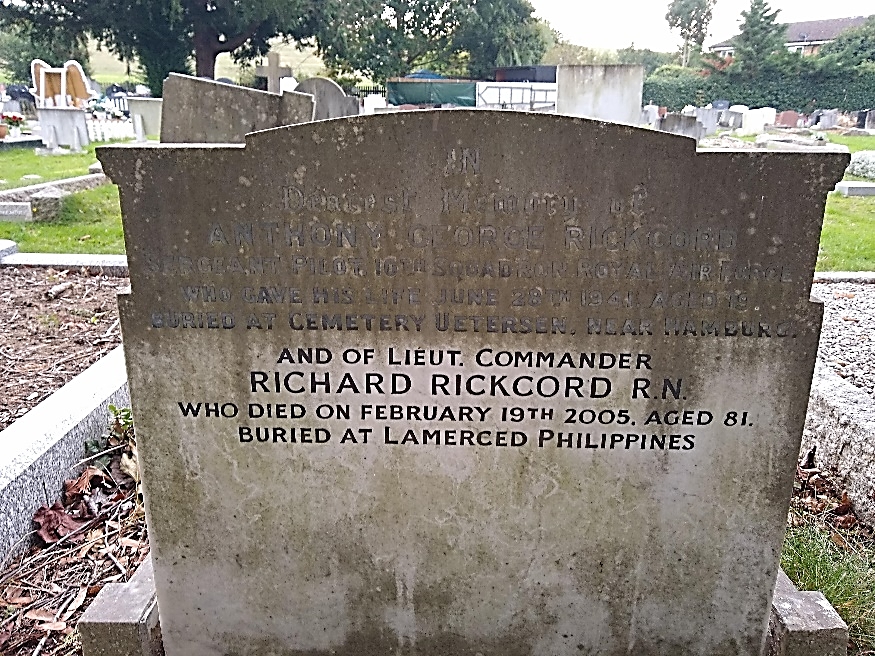
Brother of John Scott Rickcord, Anthony was a Sergeant Pilot in 10 Squadron RAF. He was killed in action over Bremen, Germany on 28 June 1941, aged 19, and was buried at Uetersen Cemetery, near Hamburg. He is remembered on the reverse of his father’s headstone in Datchet Cemetery, left. (See Rickcord, John Scott, above for family details.)
Three other Rickcord brothers also served in WWII and survived:
Richard Rickcord served aboard HMS Vengeance as a Sub-Lieutenant during WWII. He became a Lieutenant Commander and died in 2005, aged 81. He is buried at Lamerced in the Phillipines and is remembered on the back of his father’s headstone, pictured. Gerald Rickcord, Lieutenant Colonel (temporary) in the 1st Royal Ulster Rifles, was awarded the DSO in 1946. He died in 1990. Michael Rickcord, Captain, 2nd Battalion, The Queen’s Own Royal West Kent Regiment, was captured in Leros, Greece, in 1943 and was imprisoned in Germany until 1945. He died in 2017.
HAINE Richard, 1921-1944
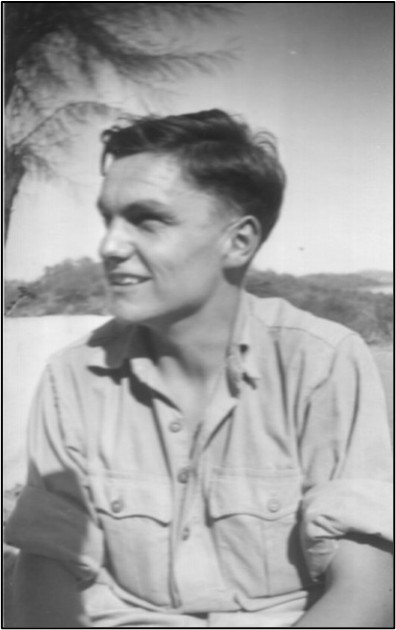
Flight Sergeant Richard Haine (left), Air Bomber, Royal Air Force, died on 6 June 1944, aged 22. Richard was born at Southlea Farm where his grandfather, Joseph William Haine, was a farmer. Richard’s father, Philip, appears to have taken on the farm after Joseph’s death in 1926, and lived there with his wife, Gladys, and children, Peter (b1916), Joan (b1919) and Richard/‘Dick’ (b1921).
Author Steve Darlow writes about Dick in his book D-Day Bombers. He joined up early in the war but his aspirations to fly were crushed by a medical officer and he remained as groundcrew. In summer 1941, he began work with 76 Squadron at RAF Middleton St George, County Durham. In 1942 he was passed fit and embarked upon his aircrew training. He attended 48 Air School, East London, South Africa and completed his initial training, but there was disappointment. He could get a plane into the air and fly it, but had difficulties landing. Eventually he was given an ultimatum; train as a bomb aimer or go back to groundcrew. He chose the former.
Dick was posted back to England and took the chance to return to Datchet. He wrote to his sister Joan, ‘Tony and I painted Datchet and district a pretty lurid colour during my short stay, in fact the other customers in The Stag told me it was about time I left as there was a danger of them running short. The Stag hasn’t changed a bit, has it? They still manage to push ’em back at a rate bordering on the alarming.’
Dick then moved on to RAF Halfpenny Green, near Stourbridge, then, in spring 1944, he was posted to No. 16 OTU (Silverstone) and then to 1645 HCU to familiarise himself with Lancasters. On 20 May 1944, Dick arrived with his crew at 5 Group’s 50 Squadron, RAF Skellingthorpe, Lincolnshire, just in time to begin their operational duties on tactical targets in support of D-Day. Sadly, Dick was killed on 6 June 1944 in the D-Day bombings. He is commemorated at Bayeux War Cemetery.
It would seem that his family had left Datchet by 1944. The Commonwealth War Graves Commission records Dick as the son of Philip and Gladys Haine of Compton, Berkshire. His probate record lists him as Richard Haine of Church Farm, Chiselhampton, Oxfordshire.