

Many thanks to everyone who attended the DVS Annual General Meeting 2023 on Wednesday 17 May at 7.30pm in the W.I. Hall, The Green, Datchet. As always, the DVS AGM was free and open to everyone.
This year’s talk: Extracting the Past
After a short business meeting to approve the minutes of the last meeting and the accounts, and to elect the committee, there was a fascinating talk by Gareth Chaffey, Deputy Regional Manager of Wessex Archaeology. Since 2007 Gareth has been closely involved in the local excavations at the Neolithic Causewayed Enclosure at Riding Court in Datchet, at Kingsmead Quarry in Horton and Richings Park in Langley. Gareth gave us an update on Riding Court and discussed some of the amazing similarities and links between the three sites as well as giving us an update on the 5,500 year-old early Neolithic Causewayed Enclosure at Riding Court.
He explained how they had thought that the finds at Kingsmead Quarry were exceptional when, in 2008, they found an early Neolithic house, in itself a very rare find. But, they went on to discover not just one but four houses on the same site. (One of these has been reconstructed at Butser Ancient Farm in Hampshire.) Then, better still, at Riding Court they found a complete Neolithic causewayed enclosure, a monumental gathering place, made up of ditch segments forming an oval shape with a perimeter of some 400m. (See the YouTube video here.)
At Riding Court, they found archaeological remains from multiple periods, providing evidence that people have occupied, settled, farmed and altered the landscape here since the end of the last Ice Age, a period of 12,000 years. Every six inches they dug down, they discovered more.
Gareth said he and his colleagues had never experienced anything like it. They unearthed a ‘ludicrous’ amount, he said, more than a tonne of finds, including 80,000 sherds of pottery, and a similar number of pieces of flint. They also excavated an oval monument within the enclosure where they dug up 5400 flints, 35kg of animal bone, 62kg of pottery sherds, and discovered evidence of a Neolithic house about 10m x 7m, similar to one at Horton. A Cemex employee even spotted a large stone on the conveyor belt which turned out to be an axe!
Gareth brought with him some large stone axes and worked flint which he invited us to handle and he explained how the trainees working on the site were unfortunately given a false impression of life as an archaeologist; since leaving Riding Court, they’ve been digging in Devon for six months and have only made one or two tiny finds!
-
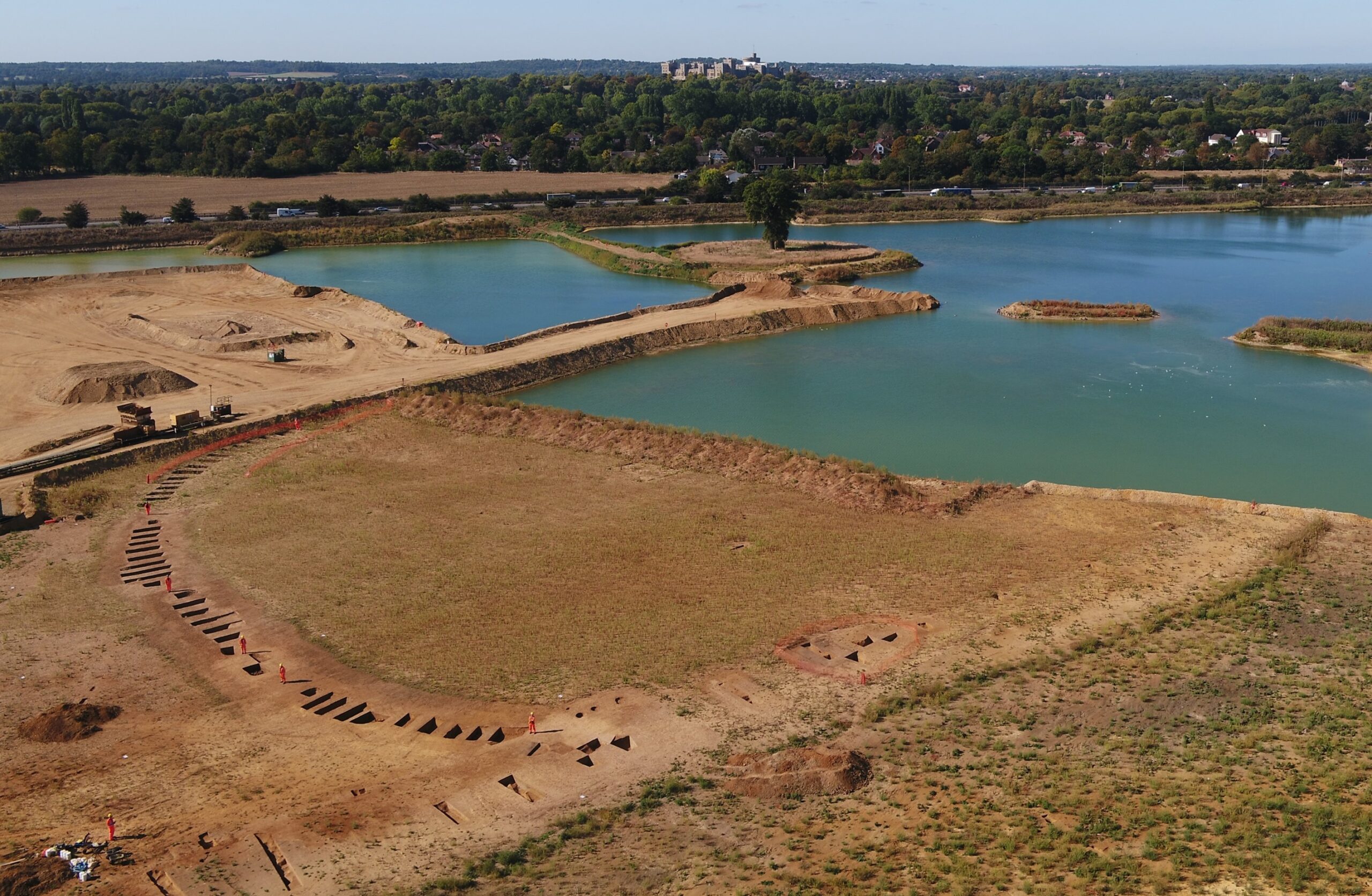
- Excavating the huge Causewayed Enclosure at Riding Court by the M4; the tiny specs of red are actually archaeologists!

-
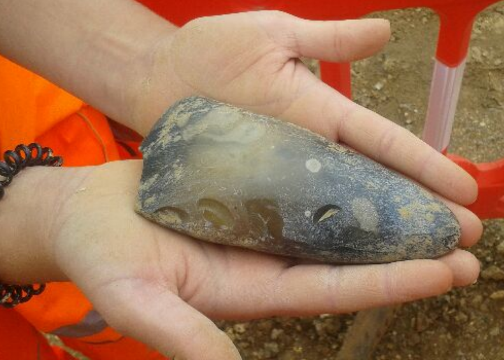
- A flint axe found near the enclosure would have been made by striking off flakes then grinding the cutting edges. Such objects would have been used to clear woodland but may have also held a symbolic role
-
- One of the exciting finds at Riding Court was a near-complete, early-Neolithic pot with a large handle, carefully placed at the base of a ditch.
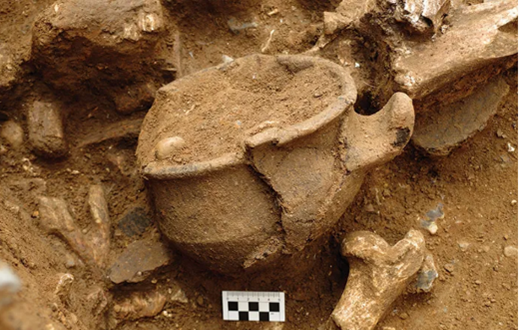
With thanks to Wessex Archaeology for the use of the photographs.
WHAT ARE CAUSEWAYED ENCLOSURES?
On the ground, a causewayed enclosure is made up of a series of ditches separated by small gaps or ‘causeways’.The Historic England website explains that this construction of an artificial boundary around an area, creating a distinction between ‘inside’ and ‘outside’, was to prove a profound social and architectural development.
Leave a Reply